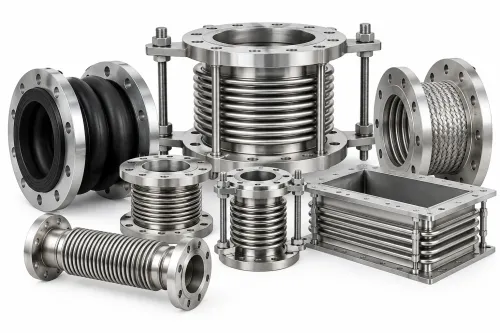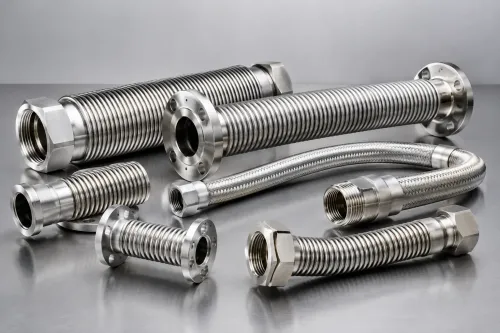


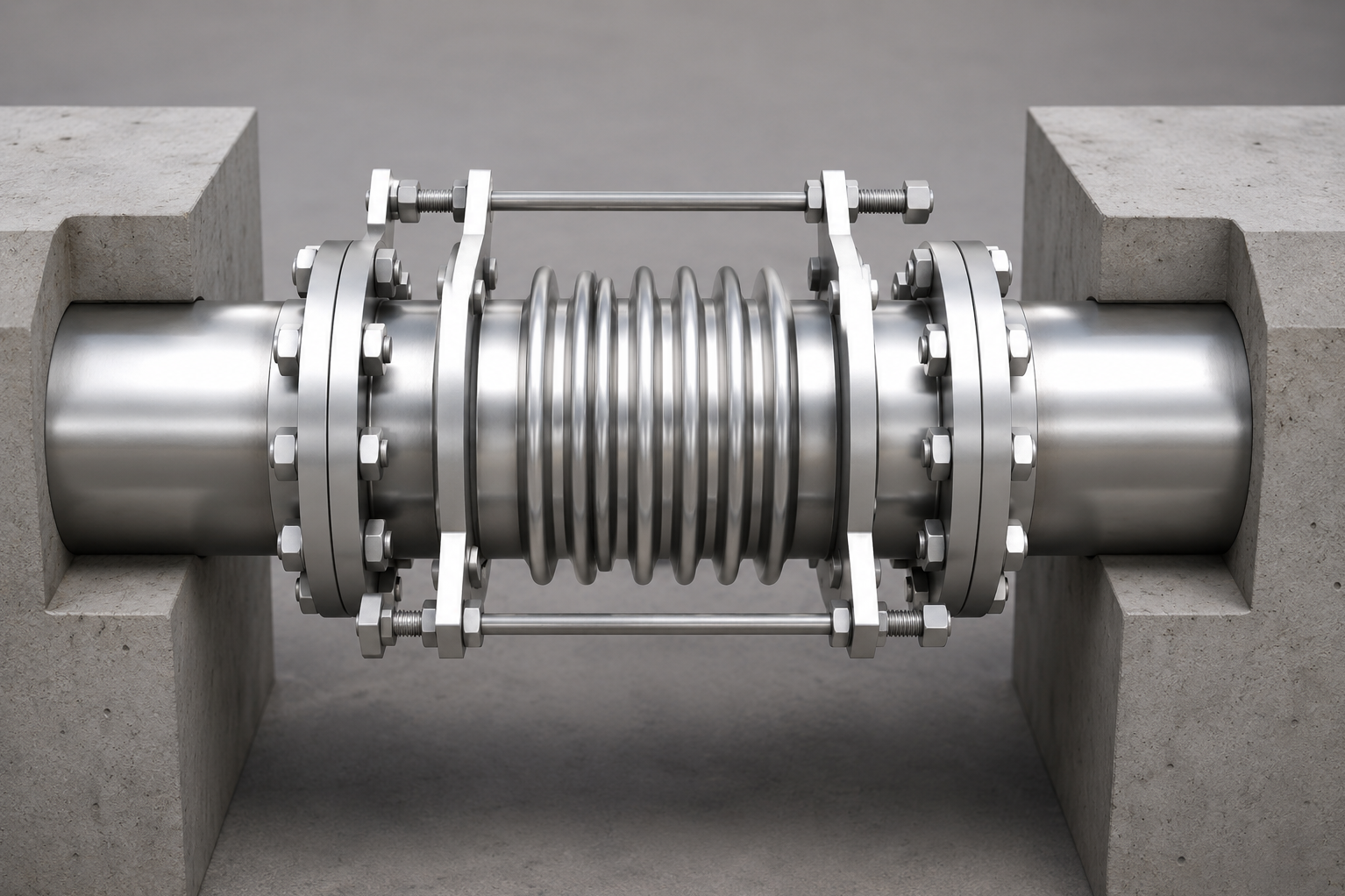
Piping systems do not always move in a straight line. Equipment layout, thermal growth, structural movement, and limited routing space can create lateral displacement that a basic axial joint is not designed to absorb. Universal expansion joints are engineered for applications requiring greater transverse movement between two connected points.
Mahantam Engineering & Services manufactures universal expansion joints in Vadodara for power, chemical, steel, cement, oil and gas, and marine applications. These joints can be customised around the piping geometry, operating conditions, movement requirements, and available installation space.
What Is a Universal Expansion Joint?
A universal expansion joint generally consists of two metallic bellows connected by a central pipe section. The two bellows work together to absorb lateral movement through controlled angular deflection.
The longer the distance between the bellows, the greater the lateral movement that may be accommodated for a given angular rotation. However, increasing the centre section also affects space requirements, stability, weight, and support arrangements.
Universal joints may be used to accommodate:
- Lateral movement in one plane
- Lateral movement in multiple planes
- Limited axial displacement
- Angular movement
- Combined thermal movements
- Equipment movement and misalignment within designed limits
Every required movement must be stated during engineering because the different movements can interact and reduce the joint’s available capacity.
Universal Joint Compared with an Axial Joint
An axial expansion joint is mainly intended for movement along the pipe centreline. It is compact and effective in straight runs but usually has limited lateral movement capability.
A universal expansion joint is longer because it contains two bellows and an intermediate pipe. Its main advantage is the ability to absorb significantly more lateral movement.
An axial design may be preferable when:
- Pipeline movement is primarily compression and extension
- Installation space is restricted
- Adequate anchors and guides are available
A universal design may be more appropriate when:
- Connected pipe sections shift sideways
- Equipment nozzles experience relative displacement
- Large lateral movement must be absorbed
- The layout cannot accommodate a conventional pipe loop
- Movement occurs in more than one direction
Tied and Untied Universal Designs
Universal expansion joints may be supplied with or without tie rods.
Tie rods are structural members connecting the ends of the assembly. In an appropriately designed joint, they restrain pressure thrust while allowing specified lateral movement. This can reduce the load transferred to the main anchors.
An untied universal joint does not restrain pressure thrust. The surrounding piping system and anchors must therefore resist the forces produced by internal pressure.
Tie rods should never be removed, loosened, or modified without engineering approval. They are functional parts of the assembly rather than shipping accessories.
Common Selection Errors
Several mistakes can reduce the effectiveness of a universal joint:
- Providing movement in only one direction when the pipe moves in multiple planes
- Ignoring the effect of internal pressure thrust
- Selecting an insufficient distance between the bellows
- Using the joint to correct major installation misalignment
- Failing to support the centre pipe adequately
- Allowing torsion to reach the bellows
- Assuming tie rods accommodate every type of movement
- Overlooking the combined effect of axial and lateral displacement
A piping analysis should confirm the movement distribution and forces before the final configuration is approved.
Evaluating Universal Expansion Joints for Gujarat Projects
Vadodara’s industrial facilities often contain congested pipe racks, process equipment, large ducts, and high-temperature lines. Universal joints can help manage movement in these layouts without requiring the space demanded by large expansion loops.
The manufacturer needs the design pressure, temperature, medium, pipe diameter, lateral movement, axial movement, angular movement, cycle requirement, end connections, and support arrangement. Material options may include stainless steel, Inconel, Monel, and Hastelloy based on corrosion and temperature conditions.
For a technically suitable universal expansion joint, provide the latest piping layout and movement calculations to the engineering team. A design review can identify whether a tied, untied, single-plane, or multi-plane arrangement is appropriate for the project.