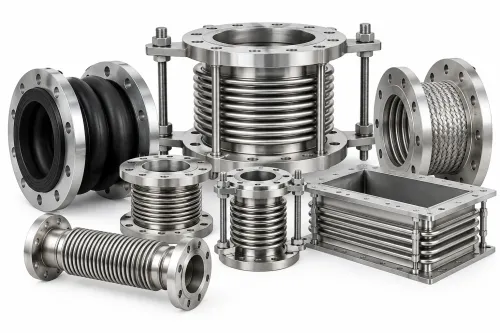
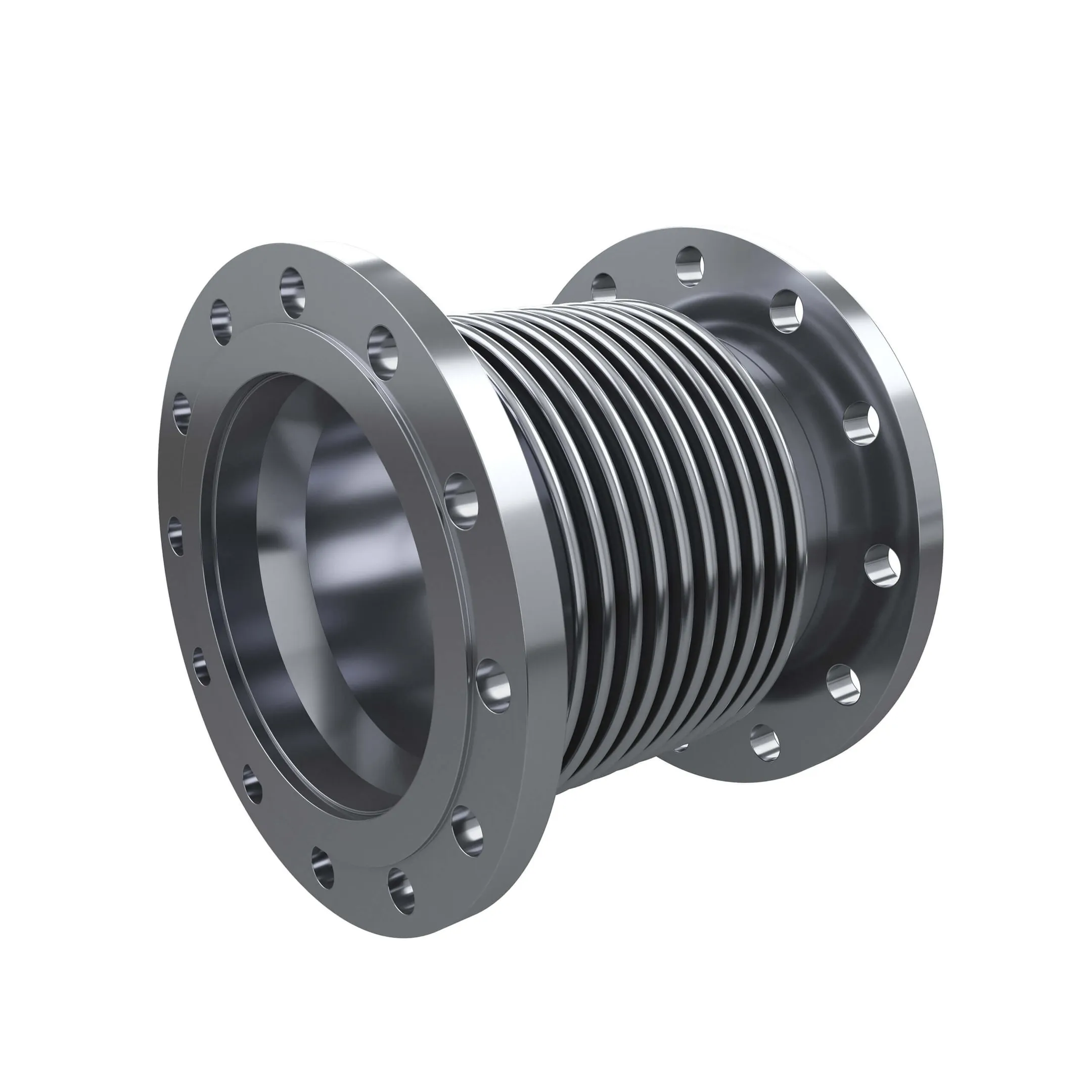
When thermal movement changes the angle between connected pipe sections, engineers may consider restrained expansion joints rather than conventional axial designs. Gimbal Expansion Joints are specifically designed to accommodate angular rotation in more than one plane while restraining pressure thrust.
This makes them different from hinged expansion joints, which are generally intended to permit angular movement in a single plane.
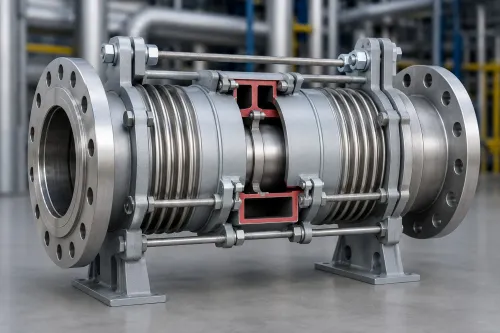
A gimbal assembly typically uses a system of rings, pins, and structural restraints around the bellows. These components allow angular rotation while carrying pressure thrust loads. The bellows therefore provides flexibility without requiring conventional main anchors to resist the full pressure thrust in the same way as an unrestrained expansion joint.
The choice between hinged and gimbal designs depends largely on piping geometry.
A hinged joint may be appropriate when movement is clearly controlled in one plane. A gimbal arrangement becomes useful when the piping configuration requires angular movement in multiple planes.
This difference can be especially relevant in three-dimensional pipe routing.
Before selecting a gimbal expansion joint, engineering teams should review several questions:
- What angular rotation is required?
- Does movement occur in one plane or multiple planes?
- What pressure thrust must the restraint structure carry?
- Are multiple expansion joints being used as part of a system?
- What are the design temperature and pressure?
- Are external loads or dynamic conditions present?
- How will the piping be supported?
Gimbal and hinged expansion joints are frequently applied as part of a coordinated piping arrangement rather than as isolated flexible components. Two or more restrained joints can work together to accommodate thermal growth while controlling the forces transferred through the system.
This is why purchasing an expansion joint purely from dimensional information can create problems. The movement behaviour of the complete pipeline needs to be understood.
Industrial projects around Vadodara, Gujarat, often involve piping that must navigate process equipment, structural constraints, elevated racks, and limited installation spaces. Angular movement solutions can be particularly useful in these layouts when conventional pipe loops would require additional space.
Mahantam Engineering & Services manufactures and supplies engineered bellows solutions for industrial piping requirements. For gimbal applications, piping drawings and operating parameters provide valuable information for determining whether the proposed arrangement suits the movement pattern.
The most useful comparison is therefore straightforward: choose a hinged configuration when controlled angular rotation is needed in one plane, and evaluate a gimbal configuration when angular flexibility is required across multiple planes. The final design should always reflect the piping system rather than the expansion joint alone.
Keywords