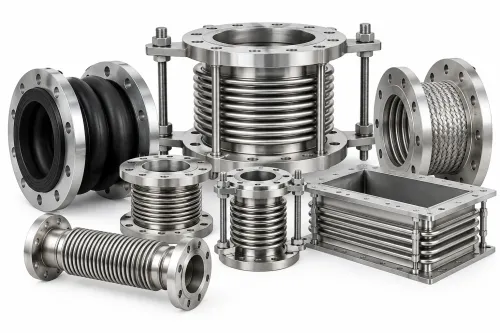
Some piping layouts require more lateral movement than a conventional single bellows arrangement can conveniently accommodate. In these situations, Universal Expansion Bellows can provide an effective engineered solution.
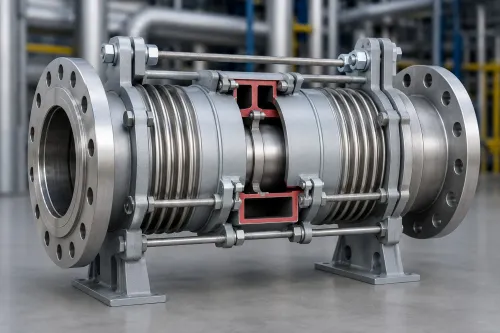
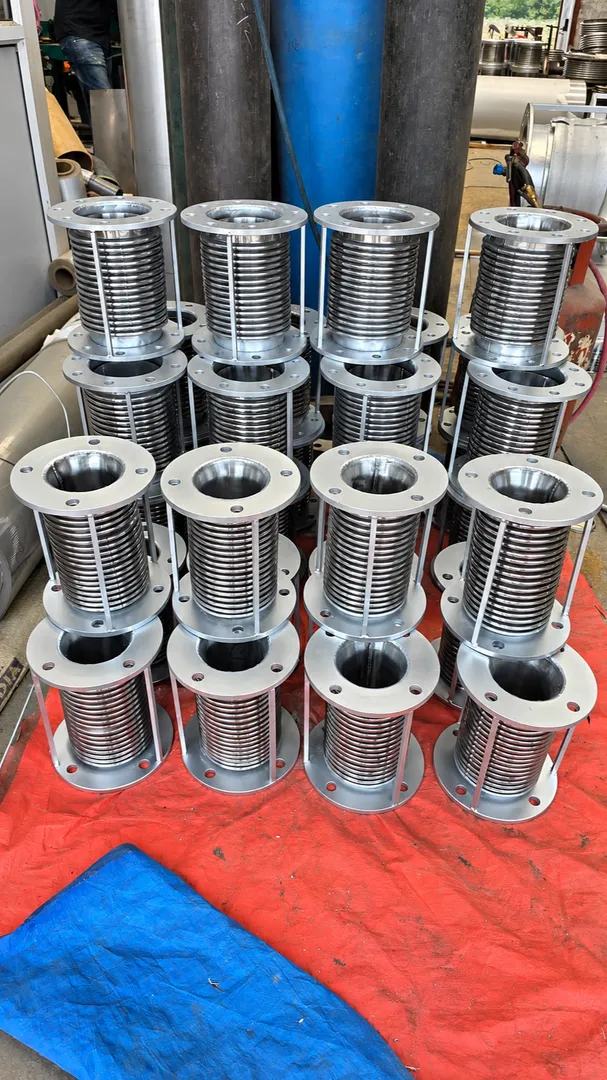
A universal expansion joint generally incorporates two bellows sections separated by a centre pipe or spool. This arrangement enables the assembly to accommodate lateral movement through angular deflection of the two bellows while it may also accommodate axial movement when the restraint configuration permits.
The distance between the bellows is important. Increasing the separation can allow a given lateral displacement to be accommodated with less angular rotation at each bellows. This makes universal designs particularly useful where piping geometry creates significant offset movement.
Consider a process line where thermal growth causes one section of piping to move sideways relative to another. Attempting to absorb that displacement using a short single bellows may require excessive deflection. A properly engineered universal configuration can distribute the movement across two flexible elements.
That does not mean a universal expansion joint is automatically the right answer whenever lateral movement exists.
Engineers should first assess:
- Magnitude and direction of movement
- Pressure and temperature
- Available installation space
- Pipe support arrangement
- Pressure thrust
- Process medium
- Required cycle life
- Need for restraints or tie rods
Tie rods are commonly associated with certain universal expansion joint arrangements. Depending on the design, they can restrain pressure thrust while allowing specified lateral movement. Their function needs to be considered as part of the complete assembly rather than as an optional accessory.
For process plants and engineering projects in Vadodara and across Gujarat, this distinction can matter when pipelines have complex routing around equipment, structures, or existing installations.
Universal expansion joints can also offer an alternative to introducing additional pipe loops where space is limited. However, comparing the two options requires consideration of piping flexibility, structural requirements, maintenance access, pressure drop, installation space, and project economics.
Mahantam Engineering & Services evaluates expansion bellows requirements according to actual operating and movement conditions. For an engineering team considering a universal design, sharing piping drawings and movement data can make technical evaluation considerably more accurate.
The key question is not whether a universal bellows is more advanced than a single bellows. It is whether its geometry and restraint arrangement better match the movement occurring in the piping system.
Keywords