
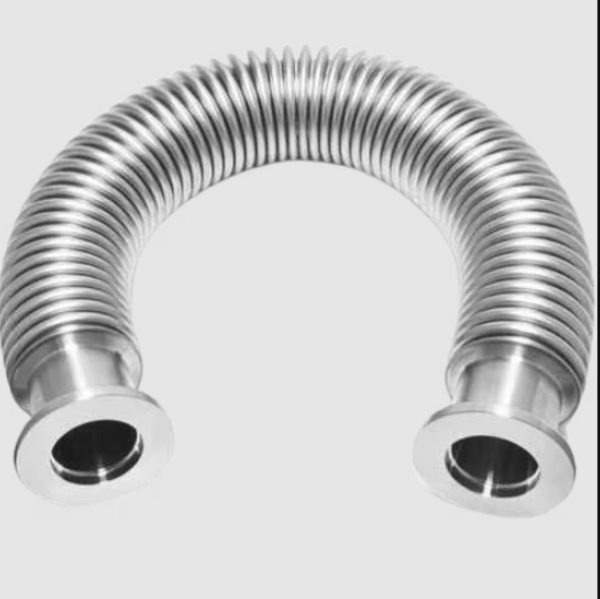
Rigid piping cannot always accommodate equipment movement, tight routing, vibration, or repeated connection requirements. Stainless steel flexible hose assemblies provide a controlled flexible connection in applications where ordinary rubber hoses may not meet the required temperature, pressure, fire-resistance, or media-compatibility conditions.
Mahantam Engineering & Services manufactures stainless steel flexible hose assemblies in Vadodara with access to in-house engineering, precision manufacturing, testing, and quality assurance facilities. These assemblies can be configured for a wide range of industrial process and utility connections.
Main Parts of a Flexible Hose Assembly
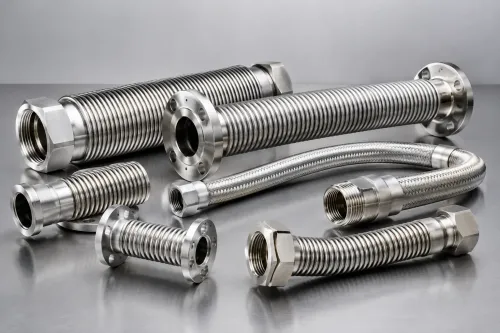
A typical assembly consists of a corrugated stainless steel hose, external braiding, end fittings, and welded or mechanically attached terminations.
Each part has a specific purpose:
- The corrugated hose provides flexibility and contains the process medium.
- The braid restrains the hose under internal pressure and improves mechanical stability.
- End fittings connect the assembly to equipment or piping.
- Collars and welds secure the hose, braid, and fittings as one unit.
- Protective covers may be added where external abrasion is expected.
Some applications require more than one braid layer to manage pressure, but the assembly must be engineered as a complete unit. Adding braid without evaluating the hose and end connections does not automatically make an assembly suitable for higher pressure.
Common Uses in Industrial Plants
Stainless steel flexible hoses are used where movement, accessibility, or equipment isolation makes rigid pipework impractical. Typical uses include:
- Steam and condensate connections
- Chemical transfer lines
- Gas supply systems
- Pump and compressor connections
- Burner and furnace lines
- Tank and vessel connections
- Loading and unloading points
- Vacuum lines
- Marine piping systems
- Instrumentation and process equipment
Their corrosion resistance and temperature capability depend on the stainless steel grade, operating medium, and surrounding environment.
Static and Dynamic Movement
One of the most important distinctions is whether the hose will experience static or dynamic movement.
A static installation may require the hose to accommodate minor misalignment or remain in a fixed bend. A dynamic application involves repeated movement during operation. Examples include reciprocating machinery, moving equipment, and frequently operated loading connections.
Dynamic service requires careful attention to bend radius, movement direction, cycle frequency, and assembly length. Twisting the hose during installation can significantly reduce its working life because corrugated metal hoses are designed to bend rather than tolerate torsional loading.
What Should Be Specified?
Complete application details allow the manufacturer to assess hose size, material, braid construction, length, and end connections. Useful information includes:
- Fluid or gas being conveyed
- Operating and design pressure
- Minimum and maximum temperature
- Required flow rate
- Type and frequency of movement
- Installation orientation
- Minimum available bend radius
- Connection type and flange standard
- External exposure conditions
- Testing and certification requirements
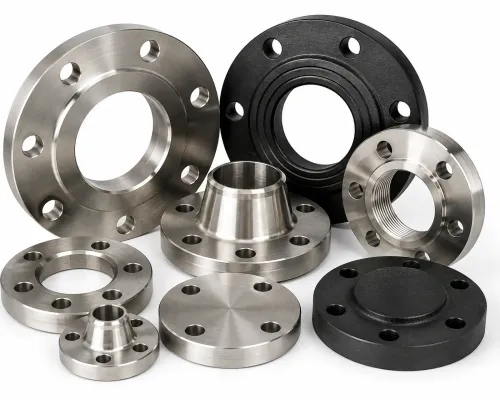
SS and MS flanges, threaded fittings, pipe ends, and other terminations may be selected according to the piping specification.
Installation Practices That Protect the Hose
A flexible hose should be installed without twisting, stretching, or compressing it beyond its designed geometry. Adequate length must be provided for the required bend, but unnecessary extra length can allow uncontrolled movement.
The assembly should also be protected from:
- Sharp external contact
- Excessive vibration
- Abrasive surfaces
- Weld spatter
- Unsupported hanging loads
- Movement below the permitted bend radius
- Corrosive chemicals collecting on the braid
Industries across Vadodara and Gujarat often operate with steam, chemicals, gases, oils, and high-temperature process media. Stainless steel flexible hose assemblies offer a practical connection method in these environments when pressure, temperature, movement, compatibility, and installation geometry are assessed together. Proper specification is the key to achieving safe flexibility without introducing avoidable stress into the piping system.