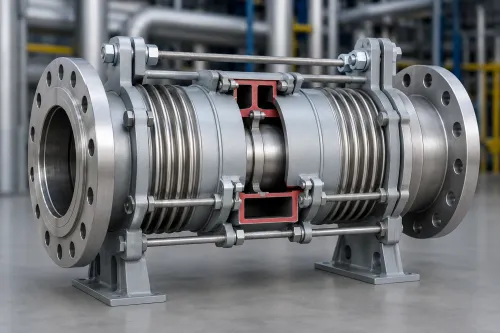


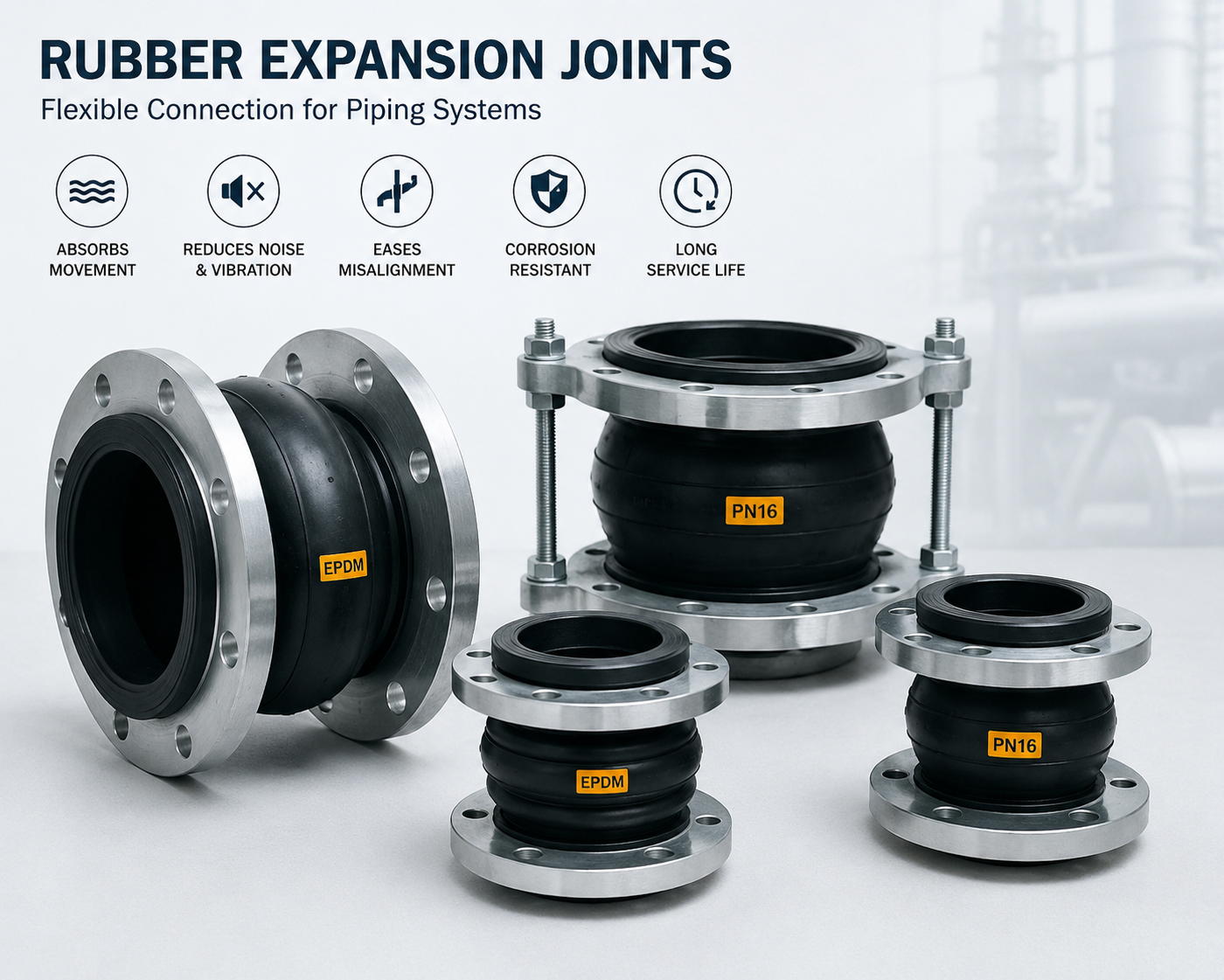
Pumps, compressors, cooling systems, and utility pipelines can transfer vibration and movement throughout an industrial installation. Rubber expansion joints are used to introduce flexibility at selected points, helping accommodate pipe movement and isolate a portion of the vibration generated by connected equipment.
For industries evaluating rubber expansion joints in Vadodara, the selection process should cover more than diameter and flange drilling. Mahantam Engineering & Services supports engineered piping requirements with in-house design, manufacturing, and quality assurance capabilities for industrial applications.
What Makes Rubber Joints Different?
A rubber expansion joint usually contains an elastomeric body reinforced with fabric or other strengthening materials. Its flexible construction allows it to absorb movement in a comparatively short installed length.
Rubber joints may be suitable for:
- Axial compression and extension
- Lateral movement
- Angular deflection
- Equipment vibration
- Minor installation misalignment
- Water hammer and pressure pulsation mitigation in suitable systems
They are generally used in liquid-service and utility pipelines where the selected elastomer is compatible with the process medium and temperature.
Typical Industrial Applications
Rubber expansion joints can be found in:
- Cooling-water circulation lines
- Pump suction and discharge piping
- Water-treatment plants
- HVAC and chilled-water systems
- Fire-water networks
- Desalination and marine systems
- Slurry lines with an appropriate construction
- Effluent and wastewater pipelines
- Chemical utility systems
Their compact size can be useful near pumps, where space is limited and vibration needs to be controlled. However, they should not be treated as a substitute for inadequate piping alignment or unsupported equipment connections.
Choosing the Correct Elastomer
The process medium has a direct effect on material selection. An elastomer that performs well in water service may not be suitable for oil, aggressive chemicals, or high-temperature fluids.
Selection factors include:
- Fluid type and concentration
- Operating and design temperature
- Continuous and surge pressure
- Exposure to oils, ozone, or weather
- Abrasion from suspended solids
- Required movement
- Frequency of pressure and temperature cycles
Common elastomer families have different resistance characteristics. The final choice should be based on verified compatibility data and the complete operating conditions rather than a broad description such as “chemical service.”
Installation Conditions That Affect Performance
Even a correctly specified joint can fail early if installed under unsuitable conditions. Several practical details require attention.
Pipe alignment
The connecting flanges should be aligned before the joint is installed. Pulling misaligned pipes into position with flange bolts can place continuous strain on the rubber body.
Support and anchoring
The pipeline needs suitable anchors, guides, and supports. A rubber joint is not intended to carry the weight of unsupported pipes or attached equipment.
Flange contact
The mating flange surface should provide even contact without sharp edges. Bolt tightening must be uniform to avoid damaging the sealing area.
Nearby equipment
When installed close to a pump, the arrangement should avoid excessive nozzle loads. The joint should also remain accessible for periodic visual inspection.
Signs That Inspection Is Needed
Maintenance teams should periodically look for:
- Surface cracking or blistering
- Bulging of the rubber body
- Leakage near the flange
- Exposed reinforcement
- Permanent distortion
- Corrosion of retaining components
- Movement beyond the designed range
Any change in operating pressure, temperature, or fluid composition should also trigger a review of the existing joint’s suitability.
Vadodara’s chemical, power, engineering, and water-handling industries use varied process media and equipment layouts. That diversity makes application-specific evaluation particularly important. Rubber expansion joints can deliver effective flexibility and vibration isolation when their elastomer, reinforcement, flange arrangement, and movement capacity are matched to actual plant conditions.