

Internal pressure acting on an expansion joint creates pressure thrust. In large-diameter or high-pressure piping, this force can become substantial and may exceed the capacity of conventional anchors or connected equipment. Pressure balanced expansion joints are designed to counteract this thrust within the assembly while still accommodating specified pipe movement.
Mahantam Engineering & Services manufactures pressure balanced expansion joints in Vadodara for industrial systems where space restrictions, equipment load limits, and high operating forces require a specialised solution.
How Pressure Balancing Works
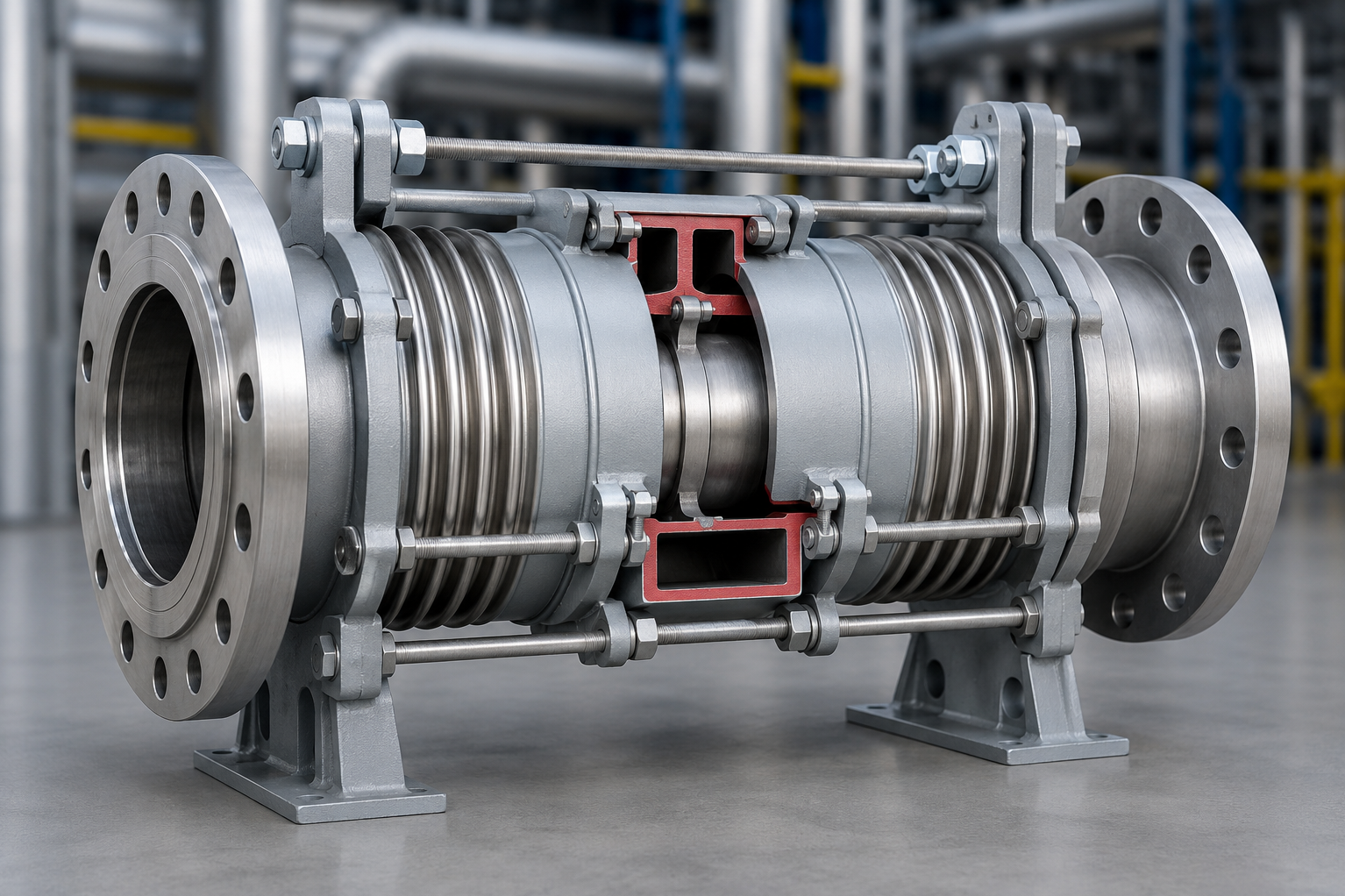
A pressure balanced expansion joint includes an additional balancing bellows with an effective area selected to counter the pressure thrust of the working bellows. Structural tie devices transfer forces between the different sections of the assembly.
The exact configuration varies according to the piping layout. Common forms include:
- In-line pressure balanced joints
- Elbow pressure balanced joints
- Tee-type pressure balanced assemblies
- Custom configurations for equipment connections
An elbow pressure balanced joint is often used where the pipeline changes direction. An in-line design may be considered where the system does not provide a convenient directional change.
Pressure Balanced Joint Compared with a Tied Universal Joint
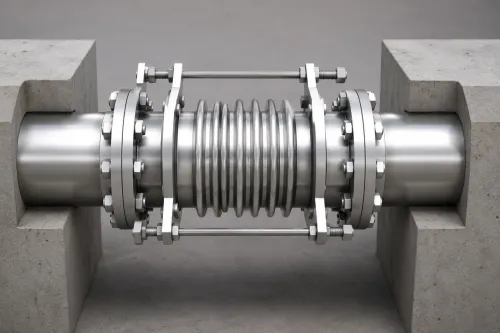
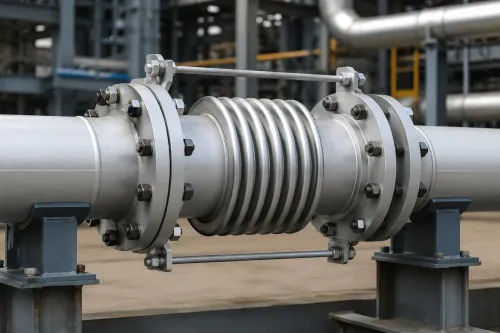
A tied universal joint restrains pressure thrust using tie rods and accommodates lateral movement through two bellows. It can be a practical choice when the movement pattern suits its geometry.
A pressure balanced joint uses a balancing bellows to counteract pressure thrust while permitting the required axial or lateral movement, depending on the configuration.
The selection generally depends on:
- Direction and amount of movement
- Piping layout
- Available installation length
- Internal pressure
- Permitted anchor loads
- Equipment nozzle limits
- Need for axial movement
- Maintenance accessibility
Neither configuration should be chosen without reviewing the forces and movement of the complete system.
Where These Joints Are Commonly Considered
Pressure balanced expansion joints may be used near:
- Turbines and compressors
- Pumps and heat exchangers
- Boilers and steam systems
- Refinery process equipment
- Chemical reactors
- Large industrial ducts
- Exhaust systems
- Steel and cement plant equipment
They are particularly relevant where a strong main anchor cannot be installed because of structural limitations or equipment sensitivity.
Information Needed Before Manufacturing
A dependable design requires more than operating pressure and pipe diameter. The engineering team should receive:
- Piping layout and orientation
- Design and operating pressure
- Maximum and minimum temperature
- Required movements in every direction
- Flow medium and material compatibility data
- Equipment nozzle-load limits
- Anchor, guide, and support locations
- Design-cycle requirement
- Test pressure and inspection criteria
- Site space and installation restrictions
Materials such as stainless steel, Inconel, Monel, and Hastelloy may be evaluated for the bellows depending on temperature and corrosion conditions. Structural components and end connections are selected according to the calculated loads and project specifications.
Vadodara and Gujarat are home to chemical, power, oil and gas, engineering, and heavy-manufacturing projects where high-pressure systems are common. Pressure balanced joints can help address difficult anchor-load conditions, but they require detailed engineering and precise manufacturing.
Project teams can approach Mahantam Engineering & Services with piping drawings, movement calculations, and operating data for a technical evaluation. The resulting design can then be developed in line with EJMA 10th Edition practices and the specific requirements of the installation.