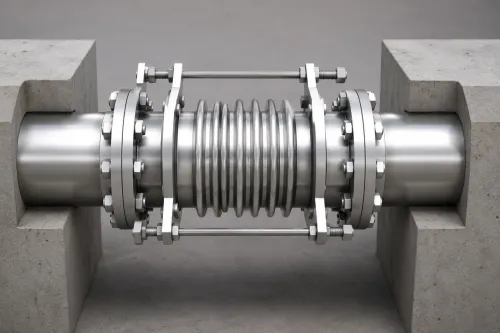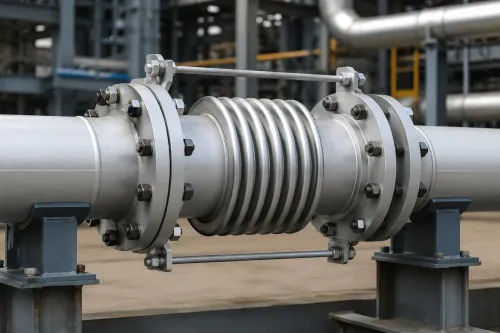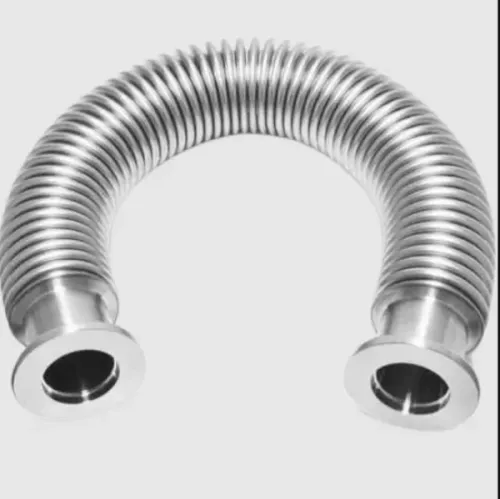


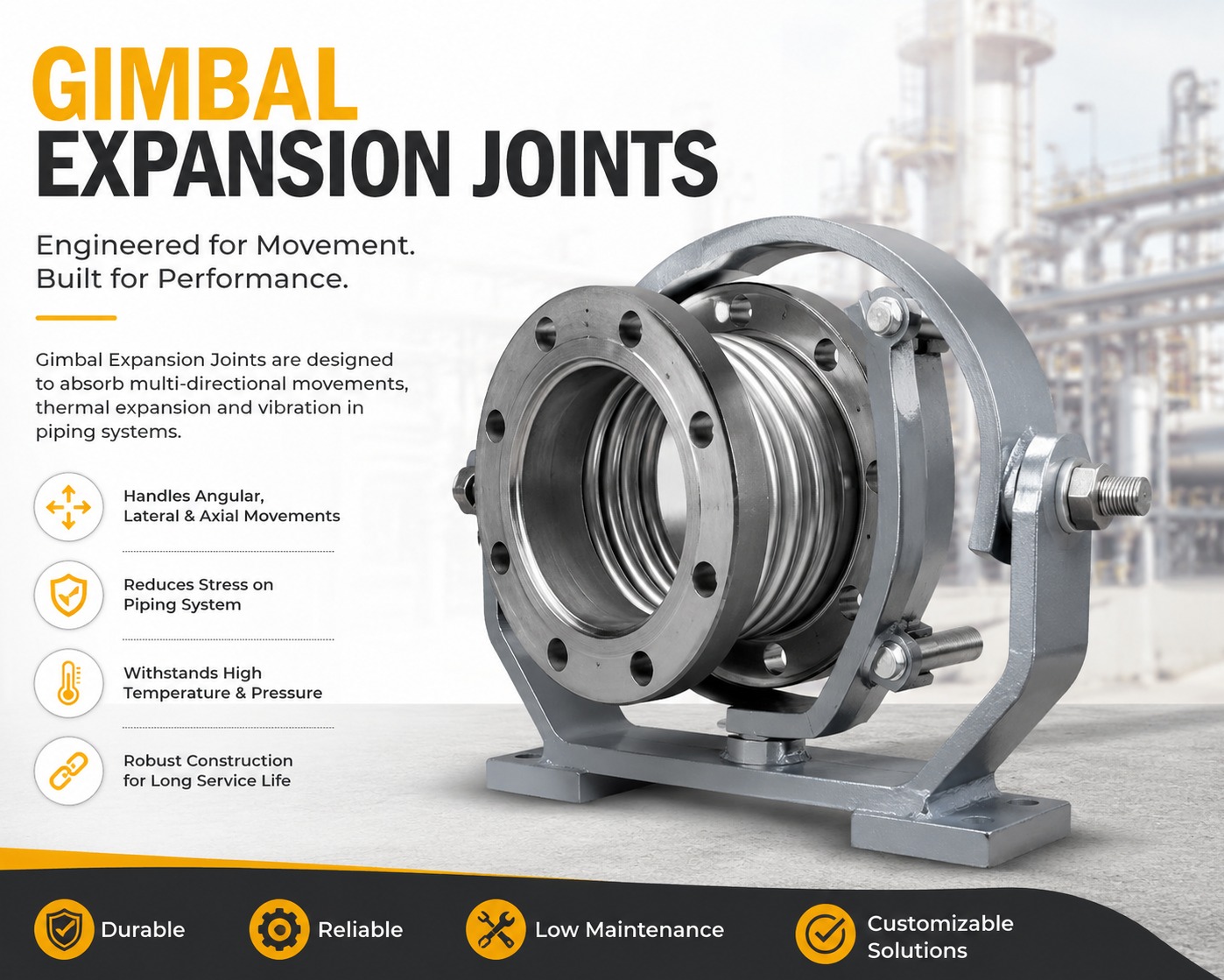
High-temperature piping systems often move in several directions as they heat up and cool down. When these movements must be controlled without transferring excessive pressure thrust to anchors or equipment, gimbal expansion joints may offer an effective engineered solution.
Mahantam Engineering & Services designs gimbal expansion joints in Vadodara for demanding industrial applications involving high pressure, high temperature, complex routing, and large pipe diameters. The correct arrangement is determined through movement analysis rather than by treating the joint as an isolated piping accessory.
How a Gimbal Expansion Joint Operates
A gimbal expansion joint contains a metallic bellows and a system of hinged structural hardware. The gimbal mechanism permits angular rotation while restraining pressure thrust generated by the internal system pressure.
Unlike a simple hinged joint, which generally rotates in one plane, a gimbal joint can accommodate angular movement in multiple planes. It is commonly used as part of a system containing two or more joints.
A properly arranged gimbal system can help absorb:
- Large lateral movement
- Angular rotation in multiple planes
- Thermal movement in complex pipe routes
- Movement in high-pressure piping
- Displacement between fixed equipment connections
The hardware must be designed to carry pressure thrust and other applicable loads while allowing the specified rotation.
Gimbal Joint Compared with a Universal Joint
Both configurations can manage lateral movement, but they do so differently.
A universal expansion joint uses two bellows connected by a central pipe. Its lateral movement is produced through the angular deflection of both bellows. If tie rods are included, pressure thrust can be restrained for the intended movement arrangement.
A gimbal system uses angular rotation at strategically positioned joints. The connecting pipe lengths translate this rotation into lateral movement. Its structural hardware restrains pressure thrust, which can make it useful in high-pressure systems where anchor loads are a concern.
A universal joint may suit a self-contained connection with known lateral movement. A gimbal arrangement may be preferable when movement is large, the piping route changes direction, or pressure thrust needs to be controlled through the joint hardware.
Applications Across Heavy Industries
Gimbal expansion joints are frequently considered for:
- Main steam piping
- Turbine and boiler connections
- Petrochemical process lines
- Refinery piping
- Steel plant gas systems
- High-temperature furnace lines
- Marine exhaust systems
- Large industrial ducts
- Chemical processing plants
They can also be used where conventional expansion loops would require excessive space or introduce unacceptable loads.
Important Engineering Checks
A gimbal expansion joint should be evaluated as part of the complete piping system. The design process normally considers:
- Required angular rotation
- Resulting lateral movement
- Distance between joints
- Internal pressure and pressure thrust
- Dead weight and external loads
- Bellows spring forces
- Operating and design temperatures
- Piping support locations
- Connected equipment load limits
- Expected movement cycles
The gimbal rings, pins, lugs, welds, and attachments must be sized for the calculated forces. They should not be modified at the site without a review by the designer.
Installation Mistakes to Avoid
Incorrect installation can restrict the joint’s intended rotation. Problems may arise when the joint is installed in the wrong orientation, structural components interfere with adjacent piping, or supports prevent the calculated movement.
Other concerns include:
- Applying torsion to the bellows
- Using the joint to correct severe misalignment
- Removing structural hardware
- Welding near the bellows without adequate protection
- Operating before permanent supports are completed
- Failing to remove identified shipping restraints
- Exceeding the specified cold-set dimensions
With two manufacturing units and in-house design, CNC manufacturing, testing, and quality assurance facilities in Vadodara, the company can develop custom joints for project-specific requirements. Manufacturing capability includes expansion joints up to 6000 mm in diameter, subject to engineering assessment.
Plant owners and EPC teams considering gimbal expansion joints should share piping isometrics, movement data, equipment loads, and support details before procurement. This enables the complete movement-control system to be evaluated instead of selecting a joint from diameter and pressure values alone.