

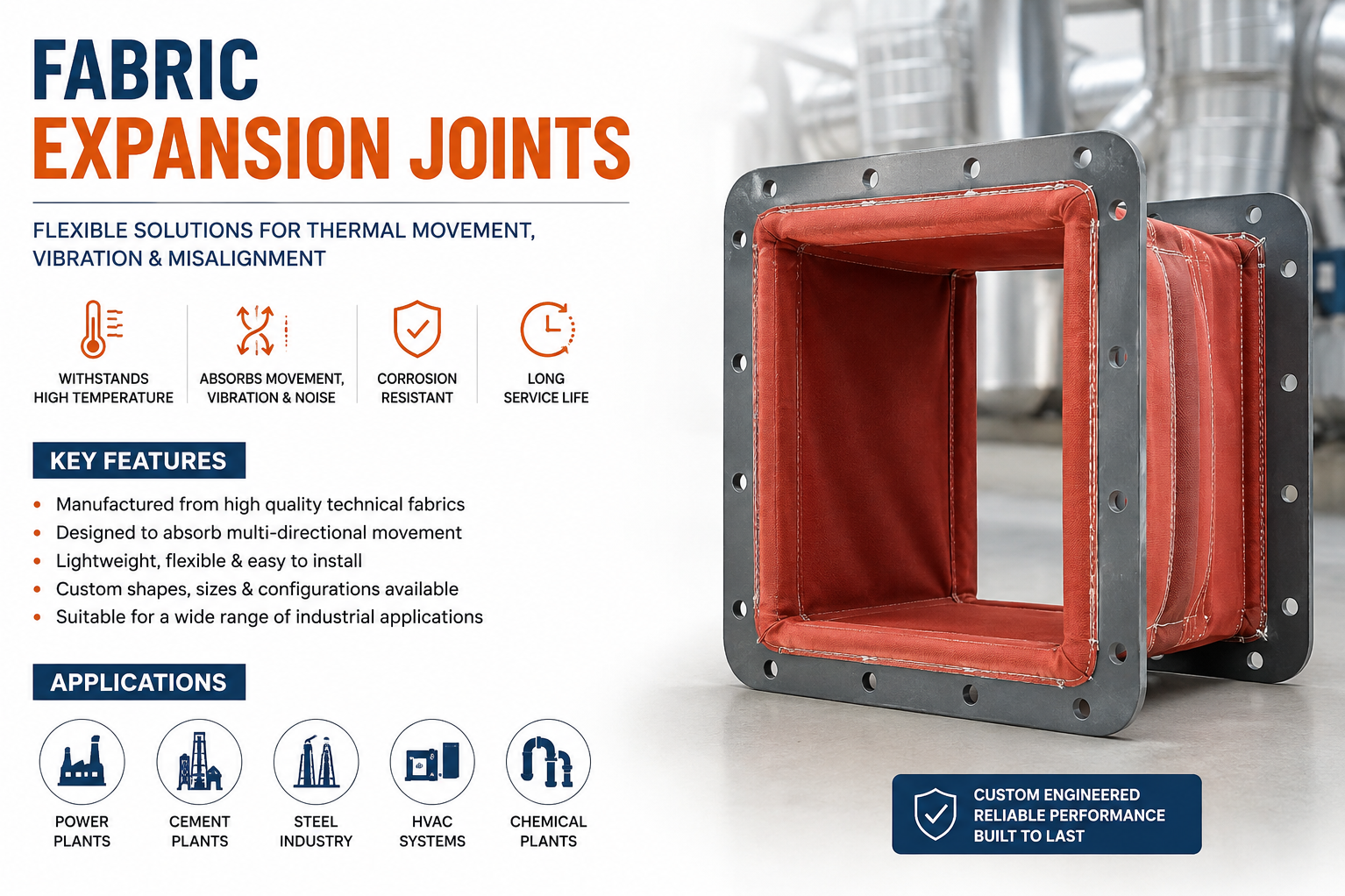
Large industrial ducts carry hot air, flue gases, dust-laden gases, and process fumes between equipment. As their temperature changes, the duct sections expand and shift. Fabric expansion joints provide the flexibility needed to accommodate this movement, particularly in systems where metallic joints may be unnecessarily rigid for the required movement range.
Mahantam Engineering & Services designs and manufactures fabric expansion joints in Vadodara for industrial ducting systems. These flexible connectors are used across power, cement, steel, chemical, and process plants where thermal movement, vibration isolation, and gas sealing must be considered together.
How a Fabric Expansion Joint Works
A fabric expansion joint contains one or more layers of flexible material installed between rigid duct sections. Unlike a metallic bellows, its flexible element can absorb movement through folding, flexing, and controlled deformation.
Depending on the construction, it can accommodate:
- Axial compression and extension
- Large lateral displacement
- Angular movement
- Misalignment between duct sections
- Vibration from fans and other equipment
- Movement in multiple directions at the same time
This multidirectional flexibility is one of the main reasons fabric joints are widely used in low-pressure ducting systems.
Where Fabric Expansion Joints Are Used
Fabric joints are commonly installed near equipment or at points where substantial duct movement is expected. Typical applications include:
- Boiler and furnace ducting
- Flue gas systems
- Air preheater connections
- Induced-draft and forced-draft fans
- Gas turbine exhaust systems
- Cement kiln and clinker cooler ducts
- Dust collection systems
- Scrubbers and pollution-control equipment
- Steel plant process ducts
- Chemical processing ventilation systems
The specific fabric construction must match the temperature, gas composition, pressure, movement, and external environment of the application.
Layers Within the Flexible Element
A fabric expansion joint may contain several functional layers rather than a single sheet. Each layer performs a different role.
The gas-seal layer limits leakage of the process medium. An insulation layer helps manage high temperatures and protects outer materials. Reinforcement provides mechanical strength, while the external cover shields the joint from weather, abrasion, or environmental exposure.
Material selection may depend on:
- Continuous and peak operating temperatures
- Chemical content of the gas
- Moisture and condensation
- Abrasive particles
- Pressure or vacuum conditions
- Risk of external weather exposure
- Required fire resistance
- Expected number of movement cycles
An incorrect material combination can result in cracking, delamination, chemical degradation, or premature loss of sealing performance.
Why the Metal Frame Matters
Although the flexible belt receives most of the attention, the supporting steelwork is equally important. The complete assembly may include backing bars, clamps, internal sleeves, flow liners, insulation pillows, and attachment frames.
A flow liner can protect the fabric from direct contact with high-velocity or abrasive gas. An insulation pillow may prevent hot particles from collecting inside the joint cavity. The frame must also maintain the required installation gap and avoid sharp edges that could damage the flexible element.
Design Inputs Needed from the Plant
Before engineering a fabric expansion joint, the manufacturer normally requires:
- Duct dimensions and orientation
- Operating and maximum temperature
- Internal pressure or vacuum
- Gas composition and particulate content
- Axial, lateral, and angular movements
- Gas velocity and flow direction
- Existing frame details
- Installation environment
- Insulation requirements
- Maintenance and accessibility conditions
For plants in Vadodara and other industrial areas of Gujarat, local engineering support can be especially useful when an existing duct connection has limited space or requires a replacement matched to site dimensions.
Fabric expansion joints are not standard pieces of flexible cloth placed between ducts. They are engineered assemblies whose performance depends on coordinated selection of the flexible layers, insulation, frame, liner, and clamping system. Accurate application data is therefore the foundation of dependable duct movement control.