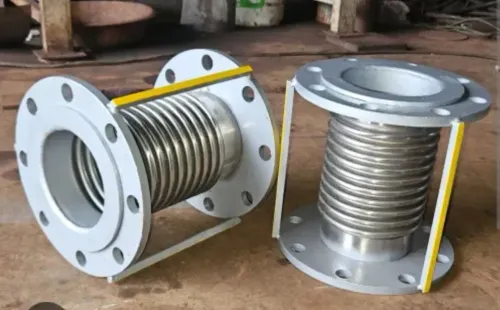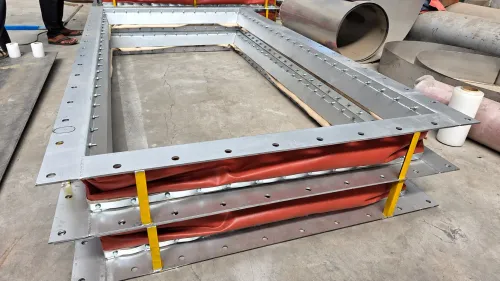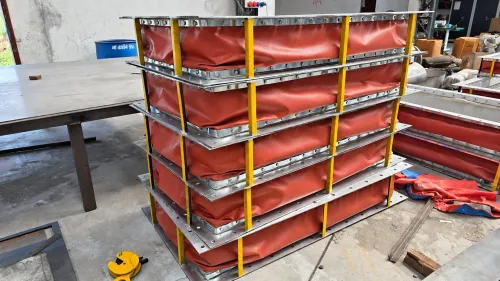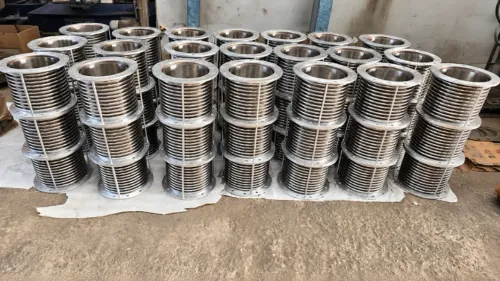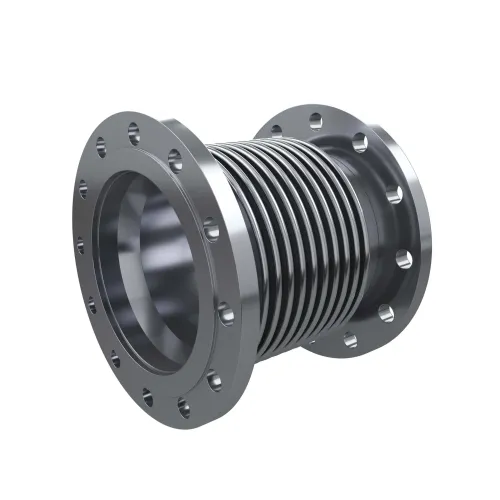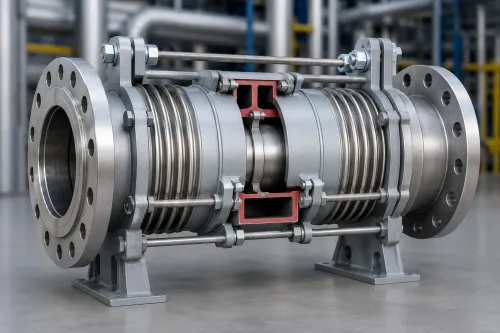
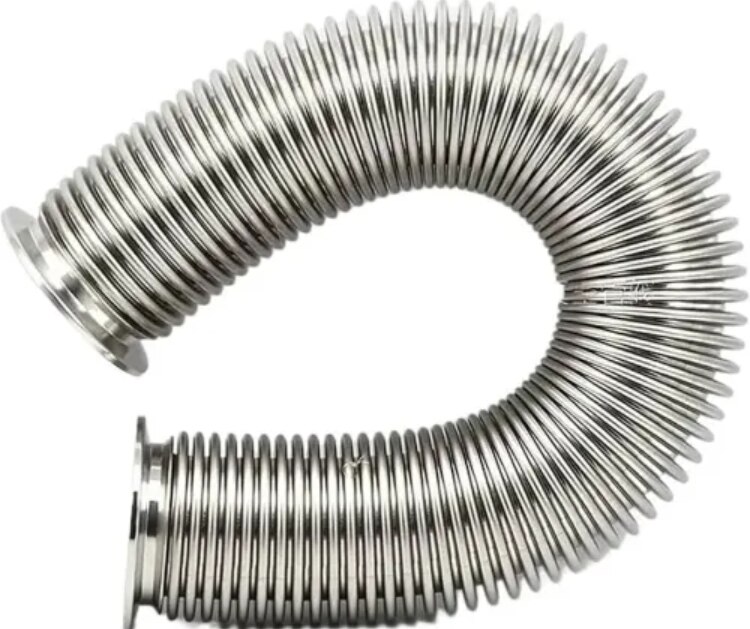
A stainless-steel bellows can crack from vibration even when the connected pump, fan, or compressor appears to meet its machine-vibration limit. By the end, you will be able to separate vibration fatigue from corrosion and overpressure, identify installation faults, specify the operating data a replacement requires, and plan a controlled repair in a Vadodara plant.
Key takeaways
- Separate thermal movement cycles from high-frequency vibration cycles.
- Inspect anchors, guides, braid, and pipe alignment before replacing the joint.
- Use vibration measurements and crack evidence to confirm the failure cause.
- Match pressure, temperature, movement, cycles, and connection details on the datasheet.
How Vibration Cracks a Bellows That Was Selected for Thermal Movement
A bellows selected for axial thermal movement can fail under vibration because the two loads create different cycle patterns. Thermal expansion usually produces slower displacement cycles as plant temperature rises and falls; mechanical vibration imposes repeated high-frequency axial, lateral, angular, or torsional cycles.
Even a small displacement becomes damaging across millions of cycles. Alternating stress concentrates at convolution roots and crests, weld transitions, end fittings, and heat-affected zones. Lateral and torsional movement bends or twists the convolutions, so it cannot be treated as equivalent to the same numerical axial displacement in a catalogue rating.
This is metal bellows vibration failure: a fatigue mechanism, not simply a dent or one-time overload.
Look for these field symptoms:
- Circumferential cracks around a convolution
- Pinhole leaks or unexplained pressure loss
- Permanent convolution distortion
- Polished rubbing marks on convolutions, braid, guides, or covers
- Audible rattling during machine operation
- Cracked or broken braid strands
- Contact marks against guides or covers
- Cracks at welds, end fittings, or heat-affected zones
Stainless bellows fatigue from vibration can remain invisible until leakage starts. Dye-penetrant testing on accessible welds and suspected convolution roots, followed by an appropriate leak test, provides stronger evidence than a visual check alone. Compare crack locations with operating vibration frequency, displacement direction, and cycle history before calling the damage an overload.
The Piping and Braid Faults That Multiply Vibration Damage
Unsupported piping turns ordinary equipment vibration into SS bellows vibration damage by imposing movement the joint was never designed to absorb. Missing, badly placed, or binding anchors and guides permit excessive lateral offset, misalignment, and torsion during fit-up; pipe strain then reaches the equipment nozzle.
The bellows must not carry line weight or compensate for an unplanned anchor movement.
Internal pressure creates pressure thrust and can reduce stability. If the assembly is poorly guided, the bellows may squirm sideways instead of moving along its designed axis, producing metal bellows vibration failure. Permanent offset also consumes movement capacity before operation begins.
The braid must restrain correctly without becoming another load path. Check these faults:
- Incorrect braid length or loose wires
- Broken strands
- Contact with adjacent steelwork
- A braid fitted too tightly
Each fault can transmit rubbing and local loads into the convolutions.
Compare excitation frequencies with the natural frequencies of the bellows-and-piping assembly, which depend on stiffness, pipe mass, anchors, guides, and supports.
| Excitation source | Compare with assembly natural frequency | Likely consequence |
|---|---|---|
| Pump speed | Running frequency | Resonant displacement |
| Fan speed | Running frequency | Lateral amplification |
| Vane-passing frequency | Blade-pass frequency | Repeated local stress |
| Compressor pulsation or flow excitation | Pulsation spectrum | Fatigue and braid rubbing |
A machine vibration limit is not automatically a bellows acceptance limit. The installed joint needs movement, pressure, and cycle-life assessment at its connection.
How to Prove Vibration Is the Failure Cause Before Replacing the Joint
A crack proves damage, not its cause. For SS metal bellows for vibration damage in Vadodara, preserve the failed joint and follow this sequence before ordering a replacement:
1. Isolate, depressurise, drain or purge the line, and verify zero energy. Photograph every convolution, weld, braid, guide, cover, anchor, and support before cleaning. Look for circumferential or root cracks, polished wear, braid damage, permanent distortion, rubbing, and contact with guides or covers.
2. Use dye-penetrant testing on accessible stainless welds, weld transitions, end fittings, and suspected convolution roots. Then perform a suitable leak test after isolation and depressurisation. A pinhole at a polished rubbing mark suggests fatigue; chloride pitting, wet-dry deposits, or chemical attack points to corrosion-assisted failure.
3. Measure vibration at the installed connection with an accelerometer, not only at the motor or pump housing. Record frequency and amplitude during startup, steady operation, shutdown, and upset conditions.
4. Trend the readings against pump or compressor speed, vane-passing or pulsation frequency, pressure, temperature, start-stop count, and flow transients. A peak that follows speed, rising amplitude, audible rattle, visible cracking, or any leak triggers investigation. Do not apply a universal numeric limit without the bellows design calculation.
5. Check for erosion grooves, overpressure bulging, thermal overstretching, water-hammer or slug-flow marks, vacuum deformation, and an unsuitable stainless grade. Vibration can accelerate each defect, producing stainless bellows fatigue from vibration without being the original cause. A replacement with unchanged resonance, misalignment, or binding guides can fail again.
The Datasheet Inputs That Decide Whether a Bellows Fits the Service
Provide a plant-specific datasheet before selecting SS metal bellows for vibration damage in Vadodara. “SS bellows vibration damage” is not a service specification; the connection needs declared loads, movements, environment, and fatigue life.
1. State the stainless grade, contamination exposure, process medium, chloride deposits, wet-dry cycling, chemicals, nominal diameter, number of convolutions, single- or multi-ply construction, connection type, and liner requirement. “SS” is incomplete: pitting and stress-corrosion cracking can develop, and 316 stainless is not a universal answer.
2. Record design and operating pressure, pressure thrust, maximum and minimum temperature, vacuum conditions, and any pressure, temperature, startup, shutdown, water-hammer, pulsation, or other transient event. Add measured axial, lateral, and angular movement, displacement amplitude, vibration frequency spectrum at the connection, and expected cycle count.
3. Require a drawing showing the bellows material and ply construction, spring rate, movement directions, braid construction and length, guide and anchor requirements, liner clearance, weld procedure, leak-test method, inspection records, and cycle-life calculation.
4. Do not approve thicker material or extra plies as a standalone fix. Multi-ply construction can change pressure capacity and stiffness, but it cannot remove resonance, rubbing, uneven load sharing, or misalignment; relative ply motion and forming or weld defects can still cause fatigue.
Measure the pump or fan connection with an accelerometer, not only the machine housing. A machine vibration limit is not automatically a bellows acceptance limit.
A Controlled Repair and Replacement Sequence for Vadodara Plants
A failed bellows is evidence of a system problem, not automatically a defective part. Control the energy, preserve the evidence, and investigate the installed connection before ordering a replacement.
1. Isolate the line, lock out connected pumps, compressors, fans, and valves, then depressurise, drain, or purge the process. Verify zero pressure, temperature, electrical energy, hydraulic energy, and stored movement before touching the assembly.
2. Remove the failed joint without pulling, jacking, or forcing the pipe into position. Tag and preserve it for crack-location, convolution, weld, and braid examination; polished rubbing, broken strands, and circumferential cracks can distinguish metal bellows vibration failure from overload or corrosion.
3. Inspect anchors, guides, supports, nozzle loads, pipe alignment, clearances, pressure thrust, and the measured vibration spectrum at the connection. Compare pump or compressor speed, vane-passing frequency, pulsation, startup, shutdown, and upset conditions with the observed damage.
4. Correct unsupported piping, binding guides, torsion, excessive offset, and resonance-related excitation before selecting the replacement. A thicker bellows will repeat SS bellows vibration damage if the same misalignment, rubbing, or natural-frequency problem remains.
5. During fit-up, keep the bellows neutral and untwisted. Confirm braid and liner clearances, then complete the specified weld inspections and leak inspections before reinstatement.
6. Commission in stages while trending vibration, pressure, temperature, and movement. Stop if a new frequency peak, rising amplitude, leak, or contact mark appears.
Mahantam Engineering & Services is useful when the scope requires diagnosis, replacement selection, alignment checks, installation, and commissioning records—not a like-for-like part alone.
Related products
 | Expansion Bellow MAHANTAM presents a wide range of flexible and durable expansion bellows or expansion joints. View product → |
 | Field Services Let Mahantam Industries assist you with any expansion joint repairs as well as on-site services and installation A real synergy happens between our... View product → |
Frequently asked questions
Why can a bellows selected for thermal movement fail from vibration?
Thermal expansion creates slower displacement cycles, while vibration creates repeated high-frequency axial, lateral, angular, or torsional cycles that accelerate fatigue.
Which piping and braid faults increase metal bellows vibration damage?
Poor anchoring, incorrect guides, pipe misalignment, unsupported weight, excessive movement, and damaged or loose braid can transfer more vibration into the bellows.
How can you prove vibration caused the bellows failure?
Compare crack location and pattern with operating movement, inspect the piping and braid, and record vibration during the conditions that produce the damage.
Which datasheet inputs decide whether an SS bellows suits the service?
Check pressure, temperature, movement direction and amplitude, vibration frequency, required cycles, material, connection size, and installation geometry.
What is a controlled repair and replacement sequence for a vibrating bellows?
Isolate the equipment, document the failure, correct piping and support faults, confirm the service inputs, then install and test a properly selected replacement.
Keywords