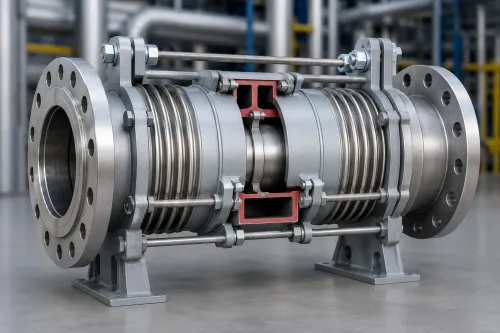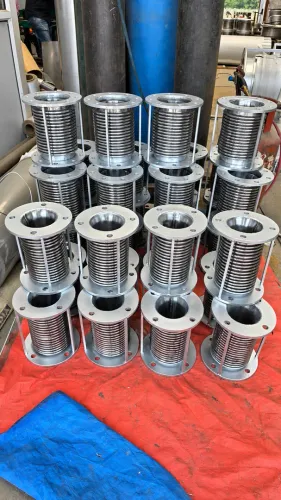
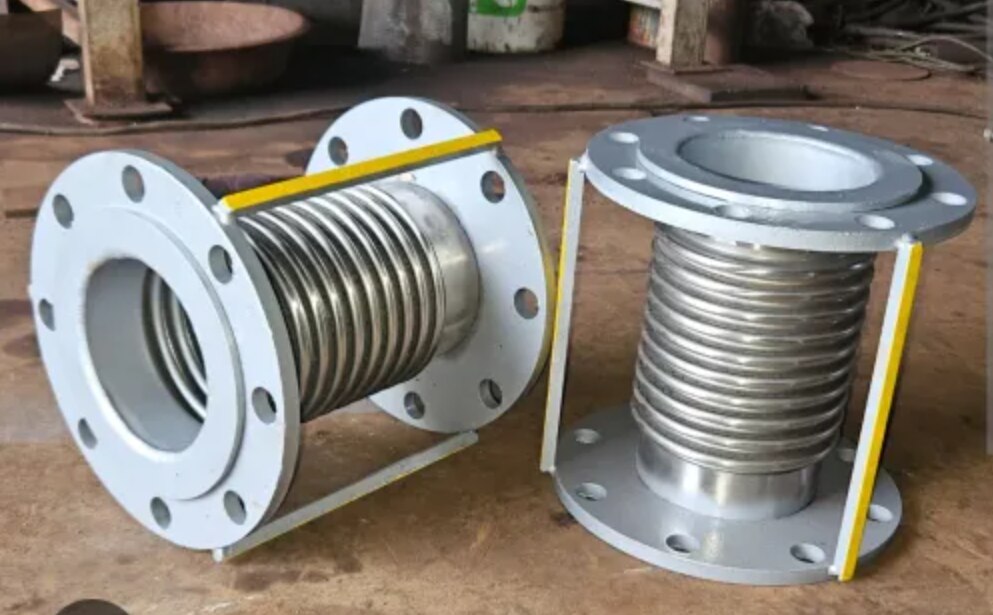
An axial bellows suits a piping system only when the required movement is primarily along the pipe centreline and the surrounding anchors and guides can control the resulting loads. By the end, you will be able to calculate the required stroke, reject unsuitable applications, compare joint arrangements, and prepare a procurement specification that a supplier can engineer rather than merely quote by pipe size.
Key takeaways
- Choose axial bellows for centreline compression or extension in a guided pipe run.
- Calculate thermal growth from pipe length, temperature change, and material expansion.
- Confirm anchors, guides, pressure thrust, cycle count, and design pressure before ordering.
- Require drawings, material details, test reports, and movement calculations from the supplier.
When is an axial bellows the correct movement solution?
An axial bellows is the correct choice when the required movement is compression or extension along the pipe centreline. A straight, guided pipe run that expands or contracts with temperature is the clearest application: anchors establish fixed points, guides keep the pipe aligned, and the bellows absorbs calculated thermal growth.
Do not treat every displacement as axial movement. Lateral movement acts across the pipe axis and needs a universal or lateral arrangement; angular rotation needs a hinged arrangement. Torsion is twisting, vibration is repeated oscillation, and settlement changes support elevation. Intentional misalignment, nozzle offset, construction error, and uncontrolled two-directional movement are not valid axial-bellows duties.
Forcing the joint into position creates sustained deflection and consumes fatigue life before normal operation begins.
For axial bellows for industrial distributors in vadodara, treat suitability as an application-screening question, not a catalogue category. Include an axial product in the range only when the customer can provide:
- Movement direction and required axial compression or extension
- Minimum, normal, and maximum temperature, pressure, fluid, and vacuum conditions
- Anchor, guide, support, and connected-nozzle restraint details
- Installation orientation and available space
- Expected cycle count and movement history
If these details are missing, a quotation based only on nominal diameter is a dimensional offer, not a defensible selection. A distributor should direct lateral, angular, torsional, vibration, or settlement problems to a different joint arrangement or a redesigned pipe system.
How do you calculate the axial stroke before selecting a joint?
Calculate thermal growth with ΔL = L × α × ΔT, where L is pipe length, α is the material’s expansion coefficient, and ΔT is operating temperature minus installation temperature. A 100 m carbon-steel run heated by 150°C expands about 100 × 12 × 10⁻⁶ × 150 = 0.18 m, or 180 mm.
Nominal pipe diameter cannot establish bellows suitability. Diameter affects pressure area, flange dimensions, and flow, but stroke comes from length, material, temperature range, and restraint. Tell an axial bellows manufacturer in Vadodara whether the joint must absorb compression, extension, or both.
- Minimum and maximum operating temperatures
- Installation temperature
- Axial movement and direction
- Expected operating cycles
- Previous movement history, if replacing a joint
| Arrangement | Movement per joint | Selection consequence |
|---|---|---|
| One joint | Full 180 mm | Higher convolution strain and lower fatigue margin |
| Two joints | About 90 mm each | Lower individual stroke, subject to anchor and guide locations |
| Three joints | About 60 mm each | Further reduced stroke, with added hardware and inspection points |
Treat those divisions as a layout starting point, not a final design. Reconcile the stroke with pipe-flexibility analysis, anchor and guide movement, support settlement, hydrotest conditions, pressure thrust, and installation tolerances. A joint sized only from the calculated thermal growth can still fail if the supports shift or the installation forces it out of alignment.
How do anchors, guides, pressure thrust, and joint types change the decision?
Anchors and guides determine whether an axial bellows can survive its first operating cycle. Anchors create reaction points; guides keep the pipe from bowing or moving laterally into the joint.
A preliminary EJMA layout places the first guide within about 4 pipe diameters and the second within about 14 diameters, then the final calculation and piping flexibility analysis confirm spacing.
An unrestrained joint does not remove pressure thrust. Calculate the anchor load as approximately pressure multiplied by the bellows effective area, then add pipe friction, weight, thermal loads, and connected-equipment reactions. That thrust reaches anchors, supports, nozzles, and the bellows assembly; weak restraint can pull equipment out of alignment or overload the convolutions.
| Arrangement | Suitable use | Unsuitable condition |
|---|---|---|
| Single axial expansion joint | Straight, well-guided pipe with centreline thermal growth | Unrestrained thrust, poor guiding, lateral movement, angular deflection, torsion, or bidirectional movement |
| Tied universal arrangement | Lateral movement with tie rods controlling pressure thrust | Pure axial movement, angular rotation, torsion, or movement beyond tie-rod geometry |
| Hinged joint | Angular deflection in a controlled two- or three-hinge system | Axial stroke, unrestricted lateral movement, torsion, or poor hinge alignment |
| Pressure-balanced joint | Axial movement where anchors or connected equipment cannot accept net pressure thrust | Simple low-complexity layouts, unplanned lateral movement, torsion, or missing balance-pipe space |
For an axial expansion bellow distributor in vadodara, require the restraint drawing, thrust calculation, guide spacing, and equipment-load check—not just size and pressure. A pressure-balanced design reduces net thrust but adds balance components, space, weight, inspection points, and calculation responsibility.
Which design details determine service life and suitability?
A defensible quote for industrial bellows sourcing in Vadodara needs more than nominal size and pressure. Review the complete movement history and require a documented cycle-life calculation.
| Design detail | What to verify | Why it matters |
|---|---|---|
| Pressure and temperature | Design, operating, upset, and hydrotest values | Pressure thrust and heat reduce fatigue margin |
| Stroke and cycles | Axial compression or extension, range, sequence, and count | A long or frequent stroke consumes convolution life |
| Geometry and alignment | Convolution shape, effective area, guides, and installation misalignment | Poor alignment adds bending stress |
| Material and corrosion allowance | Fluid, contaminants, temperature, welds, and allowance | Thin bellows lose life rapidly when corrosion attacks them |
| Vacuum | Explicit full-vacuum rating at temperature | External pressure can buckle a pressure-rated bellows |
Do not select 304 or 316L from temperature alone. Chlorides, caustics, acids, wet chlorine-bearing streams, hydrogen service, and cyclic condensation can require a higher-alloy bellows or corrosion review. An internal liner protects against erosion, but it adds pressure drop, clearance demands, condensate-trapping risk, drainage questions, and slug-flow restrictions.
Check flange bore, gasket, bolt pattern, facing, and pressure-temperature rating against ASME B16.5. Coordinate the assembly calculation with ASME B31.3, including anchors, supports, occasional loads, hydrotest, and upset conditions. A liner or reinforcement must be included in the vacuum check, not added after it.
What should an industrial distributor require before placing an order?
A quotation is not a suitability decision unless it records the service and movement data. Require the following before comparing a local supplier, reseller, or design-capable manufacturer:
- State nominal size, actual bore, design pressure, operating pressure, minimum and maximum temperature, fluid composition, vacuum requirement, and installation orientation.
- Define axial compression or extension, expected cycles, movement history, and any hydrotest or upset condition.
- Specify the flange standard, mating-face type, bore, gasket, bolt pattern, pressure-temperature rating, bellows material, corrosion allowance, and weld requirements.
- Identify liner or cover requirements, including full-vacuum stability, erosion protection, condensate drainage, clearance, and slug-flow concerns.
- List the required inspection documents: dimensional inspection, accessible-weld examination, leak or pressure-test results, material certificates, and traceability records.
Ask who performs the bellows design and fatigue calculation, and require the calculation or a documented cycle-life result in the purchase records. An axial bellows supplier in vadodara or an axial bellows manufacturer in vadodara describes location, not competence; a reseller may provide a catalogue assembly, while a design-capable manufacturer accepts responsibility for application-specific engineering.
Mahantam Engineering & Services should be evaluated by the same evidence: documented inputs, named calculation responsibility, and records matched to the service. Inspection cannot repair an incorrect movement calculation, incompatible material, or inadequate anchors.
Related product
 | Expansion Bellow MAHANTAM presents a wide range of flexible and durable expansion bellows or expansion joints. View product → |
Frequently asked questions
When is an axial bellows the correct movement solution?
Use an axial bellows when pipe movement occurs along the centreline through compression or extension, especially in a straight, anchored, guided run.
How do you calculate axial stroke before selecting a joint?
Calculate thermal growth using pipe length, temperature change, and the pipe material’s thermal expansion coefficient, then add operating and installation movements.
How do anchors and guides affect axial bellows selection?
Anchors define the movement zone, while guides maintain alignment; without them, pressure thrust and lateral loads can damage the joint.
What design details determine axial bellows service life?
Bellows material, ply construction, design pressure, temperature, axial stroke, cycle count, corrosion allowance, and installation alignment determine service life.
What should an industrial distributor require before placing an order?
Request a dimensional drawing, movement calculation, material specification, pressure and temperature ratings, test reports, inspection documents, and installation instructions.
Keywords